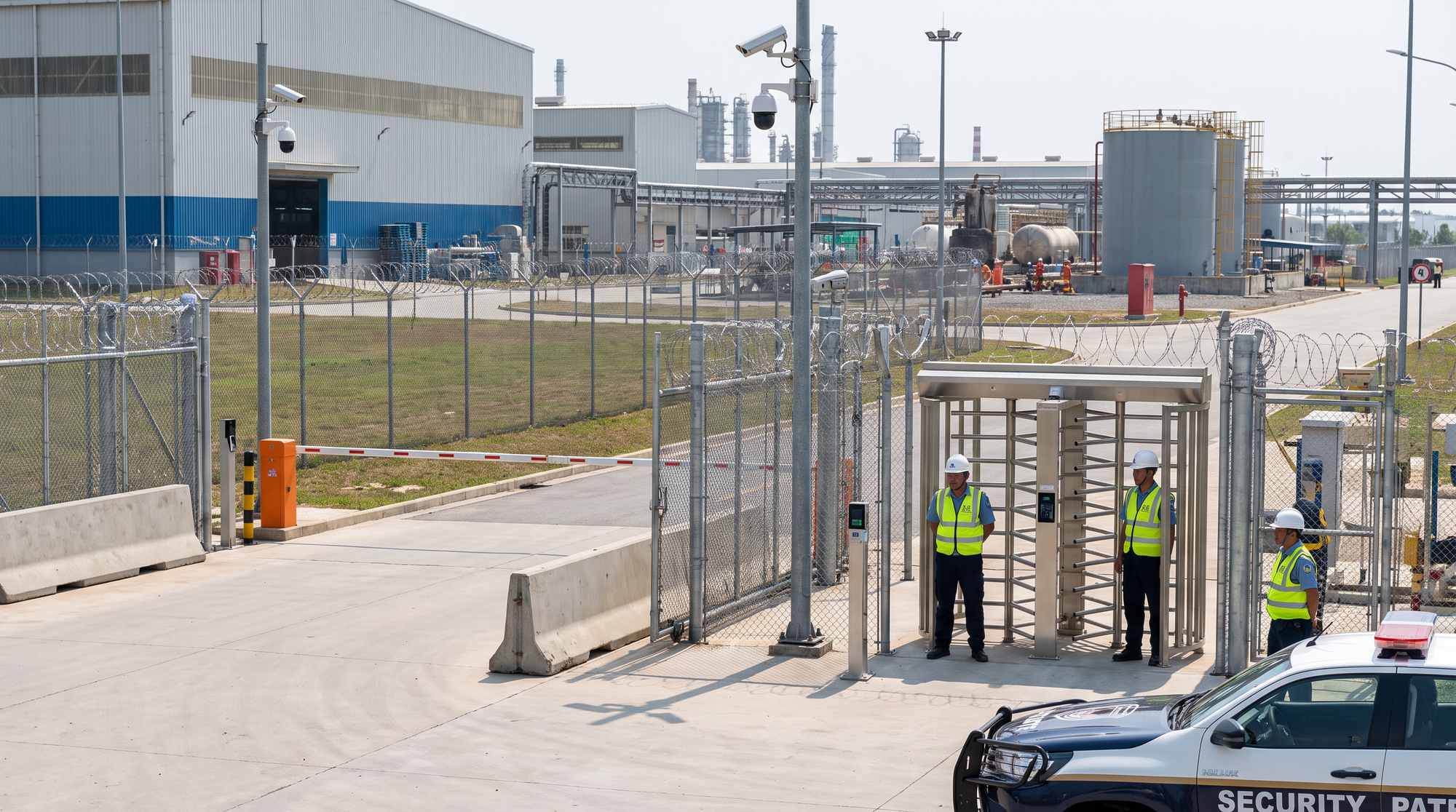
Evolving Role of Physical Security for Industrial Facilities
In a modern industry, physical security controls represent far more than just locks, fences and guards. They constitute a systemic integration of hardware, software and administrative protocols and processes meticulously designed to safeguard personnel, protect high-value assets, and ensure operational and business continuity.
The era of traditional, siloed security measures are no longer sufficient to counter inter and multi-layered threats in the face of today's industrial environments. Facilities now operate at a critical intersection where physical infrastructure and operational technology (OT) converge, meaning a breach in one domain can and will trigger catastrophic impact and failures in the other.
This reality has driven a fundamental shift in strategy, moving away from reactive or incident-based responses to more proactive, intelligence-led monitoring systems. The objective is to no longer merely react to a breach, but to create a fortified ecosystem where vulnerabilities are identified and mitigated before they can be exploited. This approach acknowledges that the robustness of an industrial operation is directly proportional to the sophistication of its integrated security framework.
Identifying Vulnerabilities in Modern Industrial Environments
The sheer scale of many industrial facilities, with their expansive footprints and complex layouts, creates inherent security challenges. Traditional surveillance methods often leave significant blindspots, providing opportunities for unauthorised access or malicious activity to go undetected. In addition, the risk of unauthorised physical access to sensitive OT environments, such as control rooms or data centres that house Industrial Control Systems (ICS), poses a direct threat to the core production processes. A physical intrusion can become a launchpad for a technical attack, or a digital attack into the network can also allow perpetrators to paralyse the physical barriers remotely. The boundary between physical and digital is virtually non-existent.
The Strategic Value of Systemic Order
Implementing a comprehesive security plan is an exercise in mitigating uncertainty. For executive leadership, meticulous security planing provides profound peace of mind, harmonised with procedural oversight, directly correlates with a reduction in operational downtime and avoidance of significant financial loss. This systemic order ensures that every potential threat vector has been considered, every asset catalogued, every response control has been defined, creating a resilient operational environment built on a foundation of strategic foresight.
Categorising Industrial Security Controls: A Framework for Resilience
To construct a robust defence, security measures must be layered and categorised according to their specific function. This strategic framework allows for a comprehensive approach that addresses threats at every stage, from initial intent to post-incident recovery. A complete strategy harmonises these different categories into a single, cohesive system.
- Deterrent Controls: These are the most visible measures, designed to discourage potential intruders before an attempt is made. High visibility surveillance cameras, prominent warning signage, and well lit perimeters communicate a clear message of high security, making the facility an unattractive target.
- Preventive Controls: Should deterrence fail, preventive controls are designed to actively block unauthorised entry and protect critical assets. This category includes sophisticated access management systems, reinforced physical barriers like high-security fencing and vehicle bollards, and biometric scanners at sensitive entry points.
- Detective Controls: These controls are engineered to identify and alert security personnel to a breach in real-time. Advance motion sensors, thermal imaging, integrated site monitoring platforms, and alarm systems are crucial for enabling a rapid and effective response the moment a security layer is compromised.
- Corrective and Recovery Controls: In the event of an incident, these controls are activated to limit damage and restore operational stability. They include emergency response protocols, automated system shutdowns to protect critical machinery, and data backup and recovery plans to ensure business continuity.
Technical vs. Administrative Controls
A truly resilient security posture depends on the harmonisation of both technical and administrative controls. Technical controls refer to the hardware and software deployed on-site, such as biometric readers, environmental sensors, and integrated surveillance platforms. In contrast, administrative controls encompass the policies, procedures and protocols that govern security operations. These include regular security audits, comprehensive personnel training, visitor management policies, and incident response planning. One is incomplete without the other; the most advanced technology is rendered ineffective without disciplined procedures to manage it.
Layered Defence: From Perimeter to Core
The methodology of "Defence-In-Depth" is paramount for protecting critical infrastructure. This strategy involves creating multiple, concentric layers of security that an intruder must overcome to reach a high-value asset. The approach begins at the outer perimeter with fencing and surveillance, progresses to building access controls, and culminates in hardened zones within the facility that protect the most sensitive assets, such as SCADA systems and control rooms. Each layer is designed to delay an intruder and provide security teams with additional time to detect and respond, ensuring that the operational core remains uncompromised.
Which of the Following is Best Practice for Physical Security Implementation?
While every industrial facility has unique requirements, a set of core best practices forms the foundation of any effective modern security strategy. The most impactful approach moves beyond deploying individual technologies and instead focuses on creating an integrated, intelligence-driven security ecosystem. This requires a commitment to continuous assessment, strategic integration, and rigorous compliance planning.
The cornerstone of best practice is the execution of a regular, detailed security risk assessment. This meticulous process identifies and analyses evolving vulnerabilities across the entire facility, from the perimeter fence to the OT network. It provides the foundational data needed to design and implement a security architecture that is precisely tailored to the specific threats an organisation faces. Without this diagnostic step, security investments risk being misaligned and ineffective.
Strategic Access Control and Identity Management
Controlling who can access specific areas, and when, is a fundamental pillar of industrial security. Best practices dictate the use of multi-factor authentication and advanced biometric integration at all critical entry points, particularly those leading to sensitive operational technology zones. Robust identity management systems ensure that access privileges are strictly enforced and auditable, creating a clear record of all movements within secure areas and preventing unauthorised individuals from reaching core operational assets.
Surveillance Integration and Real-time Monitoring
Isolated, standalone surveillance systems are relic of the past. Modern and best-practice approach calls for unified monitoring platforms that provide security personnel with a "single pane of glass" view of the entire site. This integration of video feeds, access control logs and sensor alerts enables a holistic understanding of the security environment. When an incident occurs, this unified information allows the security teams to respond not with panic, but with calculated, expert-led confidence. For organisations seeking to achieve this level of oversight, it is crucial to explore specialised services in surveillance integration that harmonises disparate systems into a cohesive whole.
Achieving Operational Resilience through Converged Security Strategies
The highest level of industrial protection is achieved through security convergence - the strategic unification of physical security, Information Technology (IT) and operational technology (OT) security. This holistic approach breaks the traditional walls between departments, creating a collaborative framework where physical access events are correlated with network activity and OT systems alerts.
Converged strategies bridge the dangerous gap between physical asset protection and technical infrastructure resilience, ensuring that a threat detected in one domain is immediately understood and addressed across all others.
Hardening Industrial Control Systems against Physical Risk
In a converged environment, protecting Industrial Control Systems (ICS) and SCADA components extends beyond firewalls and network segmentation. It requires the physical hardening of these critical assets to prevent tampering, theft, or damage. This includes securing server racks, implementing environmental controls to monitor temperature and humidity within control rooms, and ensuring all the network points are physically protected. Maintaining the robustness of the technical infrastructure is as much a physical security challenge as it is a cybersecurity one.
Adhering to Global Benchmarks: Insights from Singapore's Regulatory Framework
For organisations operating in high-stakes industries, adhering to stringent regulatory standards is non-negotiable. A prime example of a world-class regulatory environment can be found in Singapore, a global hub for finance and critical infrastructure. The nation's Infrastructure Protection Act (IPA) mandates a security-by-design approach for Critical Information Infrastructure (CII), requiring that robust physical and cyber protections are integrated from the very beginning of a facility's lifecycle. This framework, overseen by entities like the Centre for Protective Security (CPS), enforces proactive threat assessments and multi-layered security controls. While these regulations are specific to Singapore, the underlying principles - meticulous risk assessment, mandated security-by-design, and the formal convergence of physical and digital security - represent a global gold standard for fortifying industrial facilities against modern threats.
Future-Proofing through Expert-Led Compliance Planning
Navigating the complex and ever-changing landscape of industrial security regulations requires expert guidance. A forward-thinking strategy involves developing a detailed compliance roadmap built on comprehensive audits and risk assessments. This proactive planning ensures not only that current regulatory requirements are met but also that the organisation is prepared for future standards. Such a roadmap provides long-term stability and demonstrates a deep commitment to operational integrity. By understanding this meticulous process, decision-makers can fully appreciate Bio-Cognitive Solutions' approach to industrial resilience, which is rooted in expert-led, data-driven planning.
Unfortunately, fortifying an industrial facility requires a strategic partner capable of seeing the complete picture. It demands a sophisticated understanding of how physical controls, operational technology, and regulatory mandates intersect to create a truly resilient enterprise. To move beyond reactive measures and build a comprehensive defence, you must begin with a foundational analysis of your unique risk profile.
Fortify your industrial assets with a strategic security risk assessment from Bio-Cognitive Solutions.